
What Happens When Peak Produce Volume Exceeds the Forecast?
What customers should clarify internally and with their transportation providers before peak season begins.
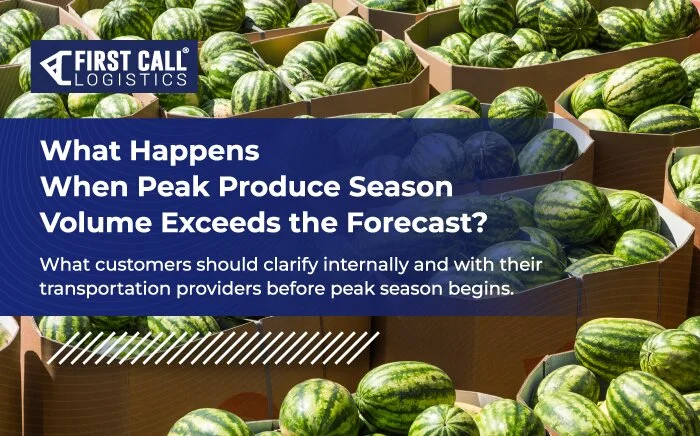
Peak week meant moving 45 loads of watermelon, nine more than the forecast called for. Part of that increase spilled onto the spot market, at rates nobody budgeted for. Not because a carrier fell through, and not because a contract failed.
Back in the spring, everything looked covered: contracted pricing confirmed on the exact lane, with primary and backup routing-guide positions in place. But as peak week approached, updated crop and customer-order information raised the expected load count. Those additional loads needed to move within the same shipping window, with less lead time than the original capacity plan allowed.
The transportation team had to determine how much of the increase the existing routing guide could absorb and how the remaining volume would be covered.
Nobody had to break a promise for this to happen. The original transportation plan was built around 36 loads, not 45. Forecasts will miss. That is expected. The real lesson is that peak-season planning has to define how additional coverage will be evaluated, approved, and secured when actual volume exceeds the forecast.
A Contract Rate is Built on a Forecast
A contract rate is typically established through a bid or negotiated award process in which an operation provides expected lane volume, service requirements, and a defined time period. Carriers use that information, along with market and network considerations, to price the lane. That expected volume helps shape both the contract rate and the capacity plan behind it. A contract rate does not automatically provide unlimited capacity for every load that materializes during peak week.
During procurement, the customer may award a carrier an expected load count or share of shipments on a lane. Once the carrier accepts the award, that volume becomes part of the customer’s planned coverage. Tender acceptance and service performance then show whether the carrier is supporting the award as expected. If performance deteriorates, the customer may reallocate future tenders or adjust the carrier’s routing-guide position.
The gap between planned volume and actual demand matters in produce because weather, maturity, retailer demand, labor availability, and harvest timing can change how much product must move and when. Because watermelon must be harvested at full maturity and does not continue ripening off the vine, growers have less flexibility to pick early and let the fruit finish later. When maturity and demand converge, more volume may need to move within a shorter shipping window.
Who manages the transportation plan varies by operation. Some produce companies manage it directly, with an internal team maintaining the forecast, carrier awards, and routing guide. Carriers and 3PLs may hold primary or backup positions within that plan or provide supplemental capacity when volume exceeds it. Other companies rely on a managed transportation provider to build and administer the plan on the customer’s behalf. Either way, the questions below apply. What changes is which side of the table already has the answer.
What to Ask Instead of “Do We Have Capacity?”
A yes-or-no answer does not reveal how much volume is actually covered, which providers are expected to handle it, or what happens once the existing routing guide can no longer absorb the increase. Some of those answers may already sit with your internal transportation team. Others should be confirmed with the carriers, 3PLs, or managed transportation providers responsible for supporting the plan.
What volume was this capacity plan built to cover?
That question opens the ones that matter:
- Is the plan based on average weekly volume or expected peak-week volume?
- How much of that volume is covered by accepted primary and backup awards?
- How much additional volume can those providers absorb above their awards?
- At what point would supplemental or spot-market coverage be required?
- What is the process for approving pricing or service changes outside the plan?
These are the terms that make those questions concrete:
| Term | What It Really Means |
|---|---|
| Forecasted Volume | The expected load count used to inform carrier pricing and capacity planning. |
| Contract Rate | Pricing established for freight tendered under the agreed lane, service, and contract conditions. |
| Awarded Volume | The expected load count or share assigned to and accepted by a provider for a lane and period. It becomes part of the customer's planned coverage but does not guarantee acceptance of every future tender. |
| Routing Guide | A structured set of shipping instructions that defines how freight should be tendered and handled, including approved providers, primary and backup positions, and escalation procedures when the first option cannot cover a load. |
| Primary Carrier Coverage | The capacity expected from the first-position provider based on its accepted award. |
| Backup Coverage | Capacity available from secondary approved providers when the primary provider cannot accept a tender or absorb additional volume. |
| Overflow Plan | The escalation and approval process used when actual demand exceeds available routing-guide coverage. |
| Spot Exposure | Loads that require transactional pricing outside the planned routing guide. |
A well-built plan does not stop at the contract rate. It connects the forecast to accepted carrier awards, defines how primary and backup positions will be used, and establishes an escalation and approval process before uncovered volume reaches the spot market.
What a Strong Overflow Response Looks Like
When actual volume comes in 20 to 30 percent above forecast, a strong response starts with visibility. Whether the transportation plan is managed internally or by a managed transportation provider, the team responsible should be able to show how much of the increase is covered, which primary and backup routing-guide options are being activated, and what portion may require supplemental or spot-market capacity.
The customer should also know when pricing or service expectations may change. Limited lead time can affect pickup availability, delivery timing, and pricing, but it should not lower carrier-qualification standards or the requirements for equipment, temperature control, and produce handling.
If the increase appears temporary, the immediate priority is to work through the routing guide and identify the loads with the most time-sensitive pickup, delivery, or produce-handling requirements. If the higher volume continues, the transportation plan should change with it. That may mean updating the forecast, adding carrier awards, revisiting pricing, or conducting a focused mini-bid instead of purchasing each additional load individually on the spot market.
How to Tell if a Provider’s Answer is Credible
Ask a provider how it supports the peak-season capacity plan, and the level of detail in the response matters.
“We have strong carrier relationships” sounds reassuring, but it does not explain what capacity is actually available. A credible answer should define the provider’s role, the volume it has accepted, the additional capacity it can confirm, the backup resources it can access, and when it will escalate a coverage gap. That is what a real plan sounds like: built before peak season, not improvised once volume runs over.
Why This Matters More During Produce Season
Produce volume can shift quickly. The financial risk increases when the additional freight must be sourced at a time when available capacity is already tight.
Contract rates are generally established for a defined period and do not immediately adjust to every short-term shift in capacity. Spot rates respond more quickly to current supply and demand. When capacity tightens, the difference between the two can widen, exposing overflow freight to pricing that was not included in the original transportation budget.
Any volume that remains uncovered after the primary and backup routing-guide options are exhausted may need to be secured at current market rates. That added cost is not a contractual penalty. It reflects what available capacity costs at that moment. The preventable risk is allowing additional volume to reach that point without a defined process for pricing, approval, and coverage.
What to Ask Before the Season Starts
Bring these questions to your next peak-season planning call.
For your own team:
- What forecast are we using, and does it reflect average-week or expected peak-week volume?
- How much of that volume is covered by accepted primary and backup awards?
- If we manage our own routing guide, what is the tender and escalation sequence when volume exceeds those awards?
- Who approves pricing or service changes outside the existing plan?
For your carriers and 3PLs:
- What load count or share did you accept on the affected lanes?
- How much additional volume can you absorb above that award?
- What additional capacity is already confirmed, and what would still need to be sourced?
- How and when will you notify us if you cannot cover a tender or additional requested volume?
- How much lead time do you need, and how could shorter notice affect pickup availability, delivery timing, or pricing?
Average-week volume, peak-week volume, and overflow volume should be planned separately before the season begins. The goal is not to predict every load perfectly. It is to build a transportation plan that can respond when the forecast changes, with clear carrier awards, backup options, decision points, and communication before uncovered freight reaches the spot market.
Planning for peak produce season? Talk to the First Call FRESH team before the busiest weeks arrive.
Peak Week Doesn’t Care About Your Forecast.
Know what your primary awards cover, where backup capacity is available, and how uncovered freight will be handled.
Plan for overflow before peak week starts.