
Why Expedited Freight for Perishables Requires a Different Playbook Than Dry Freight
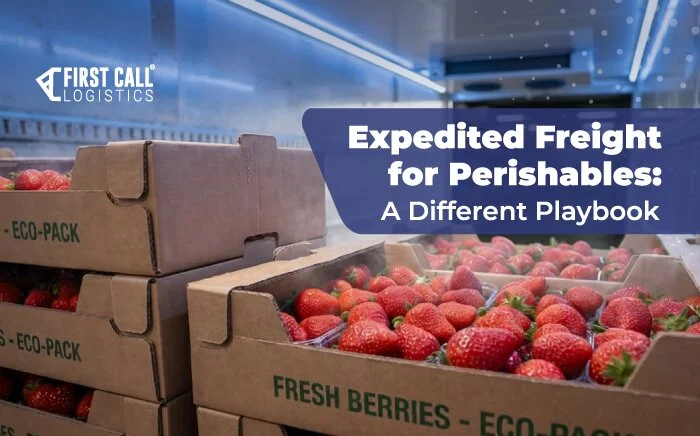
A produce operation books expedited freight for a load of strawberries going to a grocery DC outside Atlanta. Delivery needs to happen before the holiday weekend. They book through their usual freight broker, the same one they use for dry goods.
Available reefer capacity gets sourced on short notice. The carrier is dispatched. Pre-cooled trailer, product pulped correctly at loading, truck out on time. Everything on the produce operation’s end was done right.
What happens next is outside their visibility. No check-call protocol. No tracking requirement. No escalation contact. Somewhere in transit, the reefer temperature drifts. Nobody asks the driver to confirm temperature and mode. Nobody is watching the load’s pace against the delivery window. It arrives at the DC on July 3rd, outside the holiday receiving schedule. By July 5th, the product fails inspection.
The broker calls it a carrier issue. The retailer doesn’t care whose fault it was — they care that the product didn’t arrive in acceptable condition. The shipper files a claim. The strawberries are already gone.
The actual problem started before the truck left the dock. The broker booked capacity. They didn’t build a process around it. Speed protects schedules. Process protects product. When the freight has a shelf life, only one of those gets the load there in usable condition.
What Makes Expedited Perishables Different From Expedited Dry Freight
With dry freight, the primary variables in an expedited booking are speed and capacity. Can you get a truck there on time? That’s the question.
With perishable freight, speed is one variable among several, and it’s not always the most important one. A load of strawberries that moves fast on the wrong equipment, or without pre-cooling, or into a DC that isn’t receiving that day, doesn’t arrive better than a load that moves slower with the right process behind it. It arrives as a rejected load.
The variables that matter most for expedited refrigerated freight:
Equipment
Reefer capability is the starting point, not the whole answer. The trailer has to be the right type for the commodity, food-grade, properly functioning, and pre-cooled to the target temperature before loading. A trailer that arrives at ambient temperature may require significant time to reach the target operating temperature, increasing product risk during the delay.
Pre-cooling
Produce that hasn’t been pre-cooled to pulp temperature before loading will warm the trailer interior and fight the reefer unit the entire transit. A general broker booking expedited capacity doesn’t ask about pre-cooling status. A cold chain specialist does. Before the truck is dispatched, not after it arrives.
Temperature range
Different commodities require different transit temperatures, and those ranges aren’t interchangeable. Strawberries require transit temperatures at or near 32°F, and the shelf life consequences are significant. Postharvest research consistently shows that strawberries held at 50°F have a life expectancy of only one-third that of strawberries held at 32°F. Using a generic refrigerated setpoint that hasn’t been confirmed for the commodity can significantly reduce product quality before it reaches its destination.
DC receiving schedules
Grocery distribution centers don’t receive freight on a 24/7 basis. Most have specific receiving windows, and many reduce or close receiving operations around major holidays. Booking an expedited load that arrives at a DC during a closed receiving window doesn’t save the product. It just changes where it sits while it deteriorates.
Escalation
When something goes wrong on a dry freight expedited load, the problem is usually operational: a delay, equipment issue, or routing problem. When something goes wrong on an expedited perishable load, the clock is already running on the product. A provider without a defined escalation protocol for temperature excursions or missed windows doesn’t have a way to catch the problem before the load arrives.
Expedited Doesn’t Mean Skip the Planning
Expedited freight shortens the window. It doesn’t shorten the checklist.
In practice, the shorter the timeline, the more important the planning becomes. Most expedited perishable failures aren’t caused by unexpected events. They’re caused by questions that were never asked before dispatch. Was the trailer pre-cooled? Has the DC receiving schedule been checked? Is the carrier experienced with temperature-sensitive freight? Is there an escalation contact if something changes mid-transit?
A general freight broker focused on moving fast skips these steps because they aren’t part of a standard dry freight booking. A cold chain logistics specialist builds them into the process because they’ve seen what happens when they’re skipped.
Where the Process Breaks Down
Most expedited perishable failures don’t happen because of bad luck. They happen because someone in the chain treated the load like dry freight.
The carrier booking
General freight brokers build their carrier networks around dry freight. When they source a reefer carrier on short notice, they’re often pulling from the spot market, available capacity rather than vetted cold chain capacity. The carrier may have refrigerated equipment available. That doesn’t mean they understand the pre-cooling requirement, the commodity-specific temperature range, or what to do if the reefer alarm triggers mid-transit.
The load tender
A load tender that says “refrigerated” and gives a pickup and delivery address isn’t a cold chain load tender. The commodity-specific temperature requirement, the pre-cooling expectation, the pulp temperature target at origin, and the escalation contact if something changes mid-transit. All of that has to be in the load tender, in writing, before the truck moves.
The receiving window
Holiday weekends compress everything. Carriers are harder to find. DC receiving windows shrink or close entirely. A load that needs to arrive by Thursday before a holiday weekend can’t be booked Wednesday afternoon, not if the provider doesn’t already have vetted reefer capacity in the lane and current knowledge of the destination DC’s holiday schedule.
The handoff
Expedited freight moves fast by definition. That speed creates handoff risk, the moment when information stops traveling with the load. A general broker books the carrier and steps back. A cold chain specialist stays engaged: confirming departure temperature, monitoring transit, and escalating when the delivery window is in jeopardy.
Expedited Capacity Is Only Valuable If It’s Qualified
When time is limited, it’s tempting to book the first available refrigerated carrier. That’s often where the problem begins.
Fast capacity and qualified capacity are not the same thing.
A carrier that’s available on short notice may have a reefer unit, but that doesn’t mean they’ve been evaluated for the requirements of an expedited produce shipment. A qualified expedited carrier should already have been reviewed for:
- Food-grade equipment and trailer condition
- Insurance verification through independent validation resources
- FMCSA safety rating and inspection history
- Cold chain experience and operational performance
- Shipment-specific requirements for the commodity being moved
A cold chain specialist develops and maintains a network of pre-qualified carriers before expedited freight is ever booked. When a time-sensitive load comes in, the carrier evaluation has already been done. The question isn’t “who’s available” but “which of our qualified carriers is available and right for this load.”
What the Right Playbook Actually Looks Like
A provider with real cold chain experience approaches an expedited perishable booking differently at every step.
Before dispatch:
- Confirm commodity-specific temperature requirements and pre-cooling status at origin
- Verify pre-cooling — confirm the temperature-controlled truckload equipment has reached the target temperature before loading
- Confirm carrier qualification for temperature-sensitive freight, not just reefer availability
- Verify DC receiving schedule for the delivery date, including holiday closures or reduced hours
- Communicate all requirements to the carrier in writing before the truck moves
- Establish escalation contacts at origin, in transit, and at the destination DC
During transit:
- Monitor shipment status and reefer temperature data where available
- Maintain an escalation protocol so someone is notified of a temperature excursion or delivery window issue before the load arrives
At delivery:
- Document pulp temperatures at destination
- Flag discrepancies and preserve records for any claims process
None of this is complicated. But it requires a team that was built around cold chain logistics — not one that handles reefer freight as a side capability alongside their core dry freight business. The difference shows up fast when the load is time-sensitive and the margin for error is measured in hours, not days.
Before You Book Expedited Perishable Freight
Whether you’re moving a time-sensitive produce shipment or evaluating a provider’s cold chain capabilities, these questions quickly reveal whether a provider’s process is built for expedited perishables:
- Has the commodity’s temperature requirement been confirmed with the carrier?
- Has the reefer been pre-cooled to the target temperature before loading?
- Has the carrier been qualified for temperature-sensitive freight — not just reefer-capable?
- Has the destination DC’s receiving schedule been verified, including holiday hours?
- Is there a designated escalation contact if something changes during transit?
A provider with real cold chain experience will have specific, operational answers to each of these. A general broker will tell you they handle refrigerated freight all the time. That may be true. It isn’t the same thing.
Why Holiday Windows Make This Harder
Peak summer produce season and major holiday weekends create the worst possible combination for expedited perishable transportation. Carrier capacity tightens when demand is highest. DC receiving windows close or compress exactly when timing pressure is most acute. And the produce shippers who need to move product fastest are competing for the same limited reefer capacity as everyone else.
A produce shipper without a cold chain specialist actively working their lanes going into a holiday weekend is in a difficult position. Spot market reefer capacity on short notice, during peak season, before a holiday, means whatever is available, not whatever is right for the load.
The cost of getting it wrong isn’t just a rejected load. It’s the lost product, the failed inspection, the chargeback from the retailer, and the conversation with the buyer about what happened to the shipment they were expecting.
Speed protects schedules. Process protects product. In expedited cold chain logistics, only one of those keeps the load marketable when it arrives.
Moving expedited perishable freight successfully requires more than finding the first available truck. It requires planning, qualified carriers, and a process built around temperature-sensitive freight. First Call Logistics operates a dedicated cold chain team, First Call FRESH, that specializes in temperature-sensitive freight for produce, food and beverage, and other cold chain shipments. If you’re moving perishable product under time pressure, contact our team.
Moving Fast Isn’t the Same as Moving Right.
Pre-cooled equipment. Qualified carriers. DC receiving schedules. It’s a lot to confirm before a time-sensitive load moves, and one missed step is a rejected shipment.
We catch it before the truck leaves the dock.