
Holiday Special: Inside The Christmas Tree Supply Chain
Updated December 2025—This article reflects the latest available data from the USDA Economic Research Service, American Christmas Tree Association, and seasonal freight market analysis.
Millions of Christmas trees move through U.S. freight networks each holiday season, creating a short, intense shipping window that can impact execution timing and equipment availability in certain regions, shaped in part by long-standing consumer spending patterns tracked by the USDA Economic Research Service.
At First Call Logistics, we’re celebrating the Holiday Season in true logistical fashion by breaking down the where, when and how of the Christmas tree supply chain.
Bringing Trees Home for the Holidays
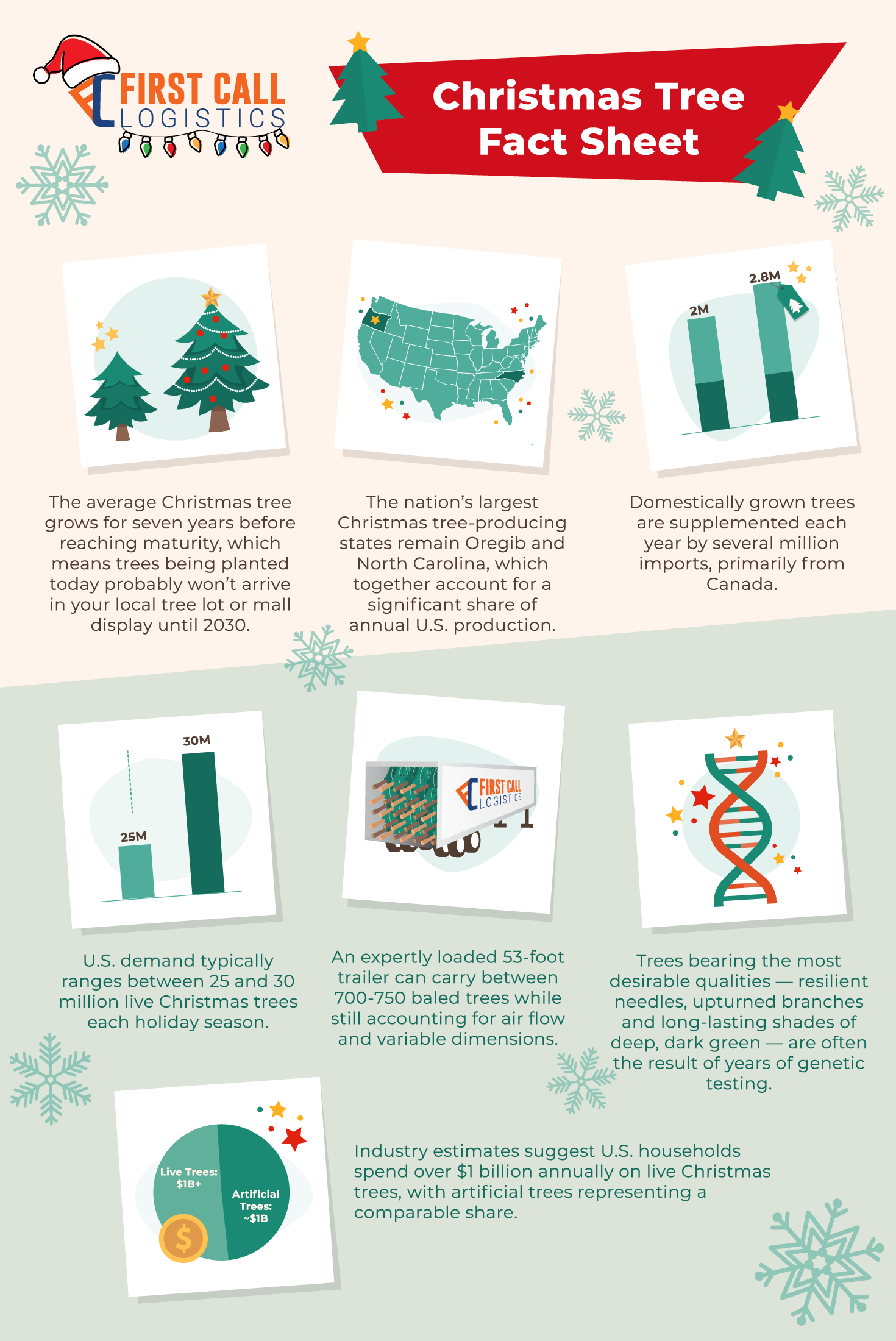
According to the American Christmas Tree Association, the vast majority of U.S. households display at least one Christmas tree each holiday season, with roughly one-quarter opting for a live tree over an artificial one. There are three primary paths a live Christmas tree takes from farm to family room:
- Choose-and-cut farms
Local Christmas tree farmers reserve large sections of ready-to-harvest trees for visiting customers each year. These farms typically provide services such as cutting, baling, and loading to help prepare trees for transport. - National Forest permits
With a special permit, select trees can be harvested outside the bounds of a commercial tree farm. Each year, the U.S. Forest Service issues a limited number of permits to holiday shoppers willing to venture onto National Forest lands to cut and transport a tree themselves, often in true Griswold-family fashion. - Pre-cut retail trees
Pre-cut trees are sold at temporary roadside lots, dedicated Christmas tree retailers, garden centers, and outside major chain stores.
The first two options are the simplest from a supply-chain perspective, as consumers handle transportation themselves. The third option, however, requires significantly more logistical coordination.
From Farm to Truck
After years of careful cultivation, trees deemed ready for harvest are individually evaluated and priced based on size and quality. Workers cut trees using chainsaws and bundle them in groups, often 12 to 14 at a time, before transporting them to nearby staging areas. In some growing regions, helicopters are used to move bundled trees from hard-to-reach terrain.
At production facilities, specialized equipment shakes loose dead needles before each tree is individually baled. A properly loaded 53-foot trailer can carry roughly 700 to 750 baled trees, accounting for airflow and variable dimensions. In many cases, trailers ship the same day trees are harvested.
Once cut, a live Christmas tree typically maintains freshness for four to five weeks, creating a narrow delivery window that places added pressure on carriers to move freight quickly and efficiently.
Christmas Tree Shipping’s Capacity Impact
Harvest season arrives earlier than many shippers expect. Lanes can begin to feel pressure as early as October, when initial harvests, including greenery used for wreaths and décor, start moving to distant markets.
The vast majority of Christmas trees ship during November and December. Peak congestion typically occurs in the week leading up to Thanksgiving, as retailers rush to stock inventory ahead of Black Friday and the start of the holiday shopping season.
Short-haul moves may ship via dry van, but longer routes into the Midwest and East Coast often require reefer equipment to protect trees from temperature extremes, including late-season heat or early winter freezes.
As a result, shippers can expect tightening reefer and van availability and firmer outbound rates from major producing regions such as the Pacific Northwest and North Carolina, which together account for a significant share of the nation’s annual Christmas tree production. That pressure does not stop at long-haul freight, as local delivery networks also feel the squeeze during the holiday peak.
Simplify your Next Shipment with First Call Logistics
Building and managing cost-efficient supply chains is a full-time job. First Call’s rare combination of in-house assets, expert problem-solving and track record of stellar customer service makes us the 3PL of choice for business partners with a wide range of shipping needs.
More Logistics Resources:
- Article: A Guide to Freight Seasonality in 2023
- Article: Truckload Supply and Demand
- Article: Safeguarding Your Business Against Logistics Fraud
- Article: The Importance of On-Time In-Full (OTIF) Delivery
- Article: Keeping Up With MABD: What It Is and Best Practices
- Article: Make Your Peak Season a Success with the Right 3PL