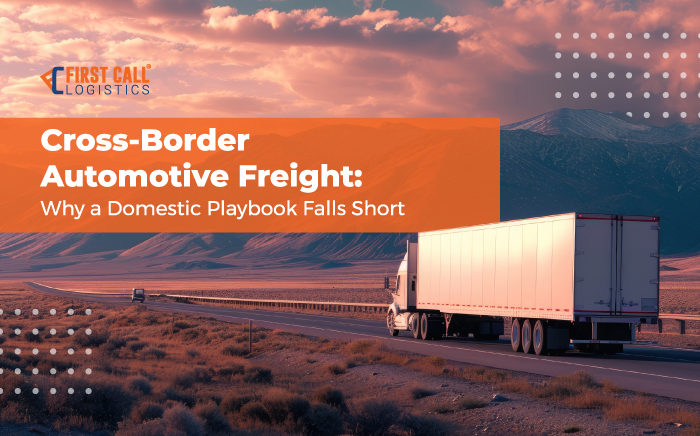
Cross-Border Automotive Freight: Why a Domestic Playbook Falls Short
A shipment of wiring harnesses leaves a supplier plant in Saltillo bound for an assembly plant in Michigan. It reaches the border on schedule. Then a discrepancy surfaces between the product description on the commercial invoice and the information being used for the Mexican export process. The shipment description does not align across the records, and the discrepancy needs to be resolved as part of the clearance process. The production-sensitive delivery window is now at risk.
The issue is a document mismatch. Key shipment information is inconsistent across the records. The problem is where the discrepancy gets caught: after the truck has already reached the crossing instead of before it left. A domestic dry-van playbook does not automatically account for customs coordination and documentation handoffs on both sides of an international border.
Why Automotive Timing Changes the Stakes
Automotive manufacturing can depend on tightly managed production schedules and sequenced parts delivery. Major manufacturers explicitly identify the timely delivery of supplier parts as a risk to maintaining production schedules. When an inbound component is tied to a production run, a transportation delay can affect more than receiving. It can affect the production schedule itself.
That timing sensitivity isn’t unique to cross-border lanes. But an international move adds something a purely domestic shipment does not have: customs and documentation requirements on both sides of the border. The shipment information supporting those processes needs to be aligned as the freight moves from supplier to plant to avoid preventable clearance delays.
What Has to Be Aligned Before the Border
A cross-border automotive shipment doesn’t move on a bill of lading alone. On the Mexican side, the export process includes a customs declaration called a pedimento, along with supporting customs information handled through the appropriate customs channel. On the U.S. side, the importer may make entry directly or work through a licensed customs broker, with responsibility for the entry remaining with the importer.
Automotive goods can also be subject to specific USMCA rules of origin when preferential treatment is claimed. Passenger vehicles, light trucks, and certain automotive parts can be subject to automotive-specific regional value requirements, with the applicable requirements depending on the vehicle or part classification and other factors. Vehicle producers also face separate Labor Value Content requirements.
First Call’s transportation role is not to determine whether a part qualifies for USMCA preferential treatment. That determination and its supporting documentation belong with the parties responsible for the origin claim. First Call’s role is to keep the transportation, shipment information, and communication aligned around that process.
Generally, a claim for USMCA preferential treatment is supported by a certification of origin containing the required data elements; no specific form is mandated. More broadly, key shipment information used across commercial and customs records needs to be accurate and consistent. Inaccurate or inconsistent product descriptions, values, party information, or other shipment details can require correction and contribute to clearance delays.
The challenge isn’t finding the requirements. It’s coordinating the customs processes on both sides of the border, the parties responsible for clearance and documentation, and the shipment information they rely on before the truck reaches the crossing.
Where Cross-Border Handoffs Break Down
Cross-border freight adds another layer to the handoff risk that can appear whenever shipment information or responsibility has to move between parties. A cross-border automotive move may involve the supplier, carrier, Mexican customs representative, U.S. importer, a licensed U.S. customs broker when one is used, and the receiving plant.
Those parties do not all perform the same task or own the same information. Customs filings, carrier information, commercial shipment details, and receiving requirements may be moving through different channels before the truck reaches the crossing.
When those handoffs aren’t aligned, the border may be where the discrepancy becomes visible even though the gap started earlier.
The border can reveal a documentation problem that started upstream.
What Cross-Border Automotive Execution Requires
Getting this right requires more than knowing that customs paperwork exists. It comes down to three things.
Key information aligned before dispatch. Key shipment details and the commercial information needed by the parties responsible for customs clearance should be aligned before dispatch. The crossing should not be the first point where discrepancies in the underlying shipment information are discovered.
Clear ownership across parties. Everyone involved should know who is responsible for providing shipment information, who is handling customs clearance, who is coordinating with the carrier, and who owns escalation when something changes.
Timing managed against the production requirement. Cross-border transit planning has to account for more than mileage. Clearance readiness, inspections, crossing conditions, and the plant’s delivery requirements all need to be weighed against the required delivery window rather than treated as a fixed transit time.
How First Call Supports the Move
First Call coordinates cross-border freight movements between the United States, Canada, and Mexico, with shipment review before dispatch, carrier alignment, communication with licensed customs brokers, and transit visibility throughout the move.
For automotive freight, that means transportation planning aligned to production and replenishment schedules, carrier coordination based on lane and equipment requirements, and active shipment oversight so developing issues, delays, or documentation questions can be communicated and addressed as conditions change.
When storage or staging is part of the supply chain plan, First Call also supports warehousing for automotive components. Inbound receiving, inventory staging, and outbound transportation can be coordinated around replenishment and delivery requirements, including buffer inventory when additional flexibility is needed between inbound and outbound moves.
Before You Ship
Before booking cross-border automotive freight, a few questions can tell you how a provider actually handles the coordination behind the move:
- Who is coordinating with the customs professionals on both sides of the border, and how is the shipment information they need communicated before the truck moves?
- If a discrepancy is identified at pickup, who gets notified, who is responsible for resolving it, and how is the transportation plan adjusted while that happens?
- Who is watching for a developing delay, and how is that communicated when the delivery window is at risk?
If your current provider can’t explain how shipment information, carrier coordination, and border timing fit into the transportation plan before freight reaches the crossing, talk to our team.
Cross-Border Automotive Freight Takes More Than a Truck
Customs coordination, documentation handoffs, border conditions, and production timing all become part of the transportation plan when automotive freight crosses an international border.
First Call helps keep carrier coordination, shipment information, customs communication, and delivery requirements aligned around the move.