
How Does the “Bullwhip Effect” Impact Supply Chains?
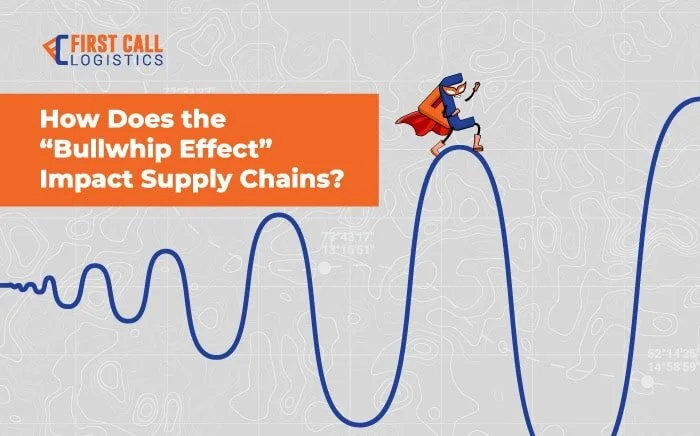
When consumer demand shifts even slightly, the ripple effect through a supply chain can be surprisingly large. A retailer adjusts an order, the wholesaler responds by adjusting theirs, the distributor does the same, and by the time the signal reaches the manufacturer, what started as a minor fluctuation has turned into a significant disruption. This is the bullwhip effect, and it plays out in supply chains across nearly every industry.
Most people got a firsthand look at it during the COVID-19 pandemic. A wave of panic buying created a perceived shortage of toilet paper that sent retailers scrambling to reorder, suppliers scrambling to produce, and manufacturers scrambling to keep up — only for demand to normalize while excess inventory was still in the pipeline. The overreaction up the chain far outpaced the actual change in consumer behavior.
This article covers why the bullwhip effect happens, what causes it to accelerate, and what shippers and supply chain managers can do to reduce its impact.
What Is the Bullwhip Effect?
The bullwhip effect can occur in almost any supply chain, but it’s most damaging in industries where production cycles are long and lead times are measured in weeks or months rather than days. When the lag between placing an order and receiving goods is significant, any overreaction to a demand signal has more time to compound before it can be corrected.

What begins as a small change in the average customer grows more exaggerated as the bullwhip effect moves up the supply chain.
The diagram above illustrates how the amplification works in practice. A retailer increases an order by 1,000 units in response to a demand signal. The wholesaler, uncertain whether demand will continue to rise, orders 2,000 units to buffer against the risk. The distributor, seeing the wholesaler’s larger order, places an order for 4,000 units with the manufacturer. By the time the signal reaches the top of the chain, a modest shift in consumer demand has produced an order four times its original size. The manufacturer has no reliable way of knowing how much of it reflects actual demand.
The Bullwhip Effect in Motion
Whitney’s Wistful Winery is running a promotion: wine tasting attendees who sign up for a club membership can buy cases of Sangiovese at half price. Whitney’s stockroom has plenty of Sangiovese on hand, so the timing feels right.
The promotion takes off faster than expected. Sangiovese cases are moving quickly, and Whitney realizes she needs more of a product that won’t be ready for at least three months post-bottling. The problem is that she launched the promotion without giving her suppliers any advance notice. Now she’s pressing vendors for raw materials they weren’t prepared to deliver on short notice, expediting shipments at a premium, and asking her team to work overtime to keep up.
Her suppliers, caught off guard by the sudden spike in orders, place their own larger-than-usual orders with their suppliers to buffer against what they now perceive as rising demand. Those suppliers do the same. By the time the signal works its way up the chain, what started as a half-price wine promotion has created a wave of inflated orders that bear little resemblance to Whitney’s actual long-term demand for Sangiovese.
This pattern plays out across industries. A flash sale, an unexpected product review, a seasonal spike that runs longer than anticipated — any of these can set the bullwhip in motion if the supply chain isn’t built to absorb and communicate demand signals accurately.
What Causes the Bullwhip Effect?
The bullwhip effect doesn’t have a single cause. Most cases trace back to a combination of the following three factors, each of which amplifies the others when they occur together.
Long Lead Times
The longer the gap between placing an order and receiving goods, the more uncertainty exists in the supply chain, and uncertainty leads to over-ordering as a hedge against risk. When Whitney needs to wait three months for new Sangiovese to be ready, any delay in sourcing bottles and corks pushes that timeline out further. Each party up the chain faces the same pressure and responds the same way: ordering more than they need to avoid being caught short. Long lead times don’t just slow the supply chain down — they give demand signals more time to distort before anyone can correct them.
Batched Orders
Ordering in bulk is generally more cost-efficient than ordering frequently in smaller quantities. But when retailers round their order quantities up or down to hit minimum order thresholds or reduce shipping costs, the signal they send to suppliers reflects a batch decision rather than actual demand. A manufacturer receiving a large batched order has no reliable way of knowing whether it reflects genuine growth in demand or a rounding decision by a retailer who ordered 500 units when they needed 340. Whitney may not have the storage capacity for more than a certain number of cases at once, so she rounds down and risks selling out before her next order arrives.
Poor Promotion Planning
Promotions are one of the most reliable triggers of the bullwhip effect because they create demand spikes that aren’t part of the normal forecasting baseline. A flash sale, a limited-time offer, or a social media-driven surge can generate orders that look like sustained demand to suppliers who aren’t in the loop. Whitney’s half-price promotion was designed to drive club memberships, not to signal long-term Sangiovese demand. Without communicating that context to her suppliers, the order spike looked like a genuine trend.
3 High-Level Fixes for the Bullwhip Effect
Reducing the bullwhip effect means reducing the gaps and distortions that allow demand signals to amplify as they move up the supply chain. The three most effective levers are supplier relationships, safety stock management, and forecasting quality.
1. Strengthen Relationships with Suppliers
Strong supplier relationships create the conditions for open, timely communication — which is the most direct antidote to the bullwhip effect. When a retailer launches a promotion, a planned product push, or any initiative that could affect order patterns, giving suppliers advance notice prevents them from misreading the spike as a permanent demand shift. Formal agreements that stabilize pricing and order cadence also reduce the uncertainty that drives over-ordering up the chain.
Whitney’s situation would have looked very different if she had briefed her suppliers before launching the membership promotion. With advance notice, her suppliers could have prepared for the temporary volume increase without placing inflated orders of their own. The communication gap is what turned a successful promotion into a supply chain problem.
2. Audit and Adjust Safety Stock Levels
Safety stock — the inventory held beyond expected demand to buffer against uncertainty — is a retailer’s first line of defense against bullwhip-driven disruptions. When safety stock levels are calibrated well, a demand spike doesn’t immediately translate into an emergency reorder. When they’re set too low, even a modest increase in demand forces a rushed order that sends distorted signals upstream.
The key is calibrating safety stock to actual demand variability rather than worst-case scenarios. Toothpaste demand is relatively stable across the year; frozen turkey demand is not. Products with consistent demand patterns need less safety stock buffer than those that fluctuate seasonally or trend-driven. Regular audits, at least quarterly for most businesses and more frequently in volatile categories, ensure safety stock levels reflect current conditions rather than assumptions made at the start of the fiscal year.
3. Fine-Tune Your Forecasting
Accurate demand forecasting is the most effective long-term defense against the bullwhip effect, and it depends on supply chain visibility. Historical sales data, fill rates, replenishment cycles, and supplier performance metrics all feed into a reliable forecast, but only if that data is accessible and current. A business operating with limited visibility into its own supply chain is essentially forecasting blind, which leads to the kind of reactive over-ordering that triggers the bullwhip in the first place.
The goal isn’t perfect prediction — demand will always have an element of unpredictability. The goal is a forecasting process disciplined enough to distinguish between a genuine demand trend and a temporary spike, and responsive enough to share that distinction with suppliers before they act on incomplete information. For a closer look at the metrics that feed into effective supply chain forecasting, see What Is a Routing Guide and The Importance of On-Time In-Full Delivery.
Keeping the Bullwhip Effect in Check
The bullwhip effect is one of those supply chain problems that tends to be diagnosed after the damage is done: excess inventory piling up, emergency freight costs mounting, and supplier relationships strained by orders that don’t reflect actual demand. The good news is that it’s largely preventable, and the fixes don’t require a complete operational overhaul.
Better supplier communication, well-calibrated safety stock, and a forecasting process built on real visibility rather than assumptions address the root causes rather than the symptoms. For most businesses, the starting point is simply closing the information gaps that allow demand signals to distort as they travel up the chain.
Supply chain visibility is the common thread running through all three fixes. For more on building the kind of operational transparency that keeps demand signals accurate, see Achieving End-to-End Supply Chain Visibility and Understanding the Seasonality of Freight, both of which cover the planning and visibility practices that reduce bullwhip risk before a disruption starts.
Frequently Asked Questions
What is the Bullwhip Effect in Supply Chain Management?
The bullwhip effect is the tendency for small fluctuations in consumer demand to produce progressively larger order swings as the signal moves up the supply chain from retailer to wholesaler to distributor to manufacturer. Each party, operating with incomplete demand information, tends to over-order as a hedge against uncertainty, which amplifies the original demand signal well beyond what actual consumer behavior warrants. The term was first used by Procter & Gamble researchers in the early 1990s to describe what they observed in the supply chain for Pampers diapers.
What are the Main Causes of the Bullwhip Effect?
The three most common causes are long lead times, batched orders, and poor promotion planning. Long lead times increase uncertainty and encourage over-ordering as a buffer against risk. Batched orders obscure actual demand by bundling purchasing decisions into quantities that don't reflect real consumption rates. Promotions and demand spikes that aren't communicated to suppliers in advance get misread as sustained demand trends, triggering inflated orders up the chain.
How Does the Bullwhip Effect Impact Businesses?
The most direct impacts are excess inventory, increased carrying costs, emergency freight expenses, and strained supplier relationships. When the bullwhip effect is in motion, businesses often find themselves over-stocked on products that had a short demand peak and under-stocked on products with sustained demand, both of which create customer service and financial consequences. In severe cases, the distortion can reach far enough up the chain to affect manufacturing schedules and raw material availability.
How Can Businesses Reduce the Bullwhip Effect?
The three most effective approaches are strengthening supplier relationships through open and timely communication, calibrating safety stock levels to actual demand variability rather than worst-case assumptions, and improving demand forecasting through better supply chain visibility. Giving suppliers advance notice of promotions or planned demand changes is one of the simplest and most immediately effective steps a business can take. The common thread across all three fixes is reducing the information gaps that allow demand signals to distort as they move upstream.
What is Safety Stock and How Does it Help?
Safety stock is inventory held beyond expected demand to buffer against uncertainty and unexpected demand spikes. When calibrated correctly, it prevents a temporary demand increase from triggering an emergency reorder that sends distorted signals to suppliers. The right safety stock level depends on the demand variability of the specific product. Stable products need less buffer than those with seasonal or trend-driven fluctuation patterns. Regular audits ensure safety stock levels reflect current conditions rather than outdated assumptions.
How Does Supply Chain Visibility Reduce the Bullwhip Effect?
Supply chain visibility gives every party in the chain access to more accurate, real-time demand information rather than relying on the orders of the party immediately below them. When retailers share point-of-sale data directly with suppliers, manufacturers can respond to actual consumer demand rather than a distorted version of it filtered through multiple layers of ordering decisions. Better visibility reduces the uncertainty that drives over-ordering and makes demand forecasting more reliable across the entire supply chain.
Supply Chain Disruptions Don’t Have to Catch You Off Guard
Managing demand fluctuations is easier with a logistics partner that provides real visibility into your supply chain. First Call works with shippers to keep freight moving efficiently and help prevent small demand shifts from turning into larger operational problems.