
How Freight Classification Affects Your Bottom Line
Freight classification directly impacts less-than-truckload (LTL) shipping rates. When a shipment is assigned the wrong freight class, it can lead to reclassification fees, delivery delays, and unexpected cost increases.
Understanding how freight classes are determined helps shippers reduce billing disputes, improve rate accuracy, and build more predictable transportation budgets.
What is Freight Classification?
Freight classification is a standardized system used to categorize less-than-truckload (LTL) shipments based on their transportability. Carriers evaluate factors such as density, handling requirements, liability risk, and stowability to determine the appropriate freight class for each shipment.
Freight classes were developed by the National Motor Freight Traffic Association, to group LTL shipments with similar levels of transportability and liability. Since each group or class includes a variety of products, an NMFC code is assigned to further specify the type of item being shipped. Freight classes create a standard for comparison that can be used by both shippers and carriers in rate negotiations and logistical planning.
Assigning the correct freight class is essential to receiving accurate quotes for shipping rates, and for helping carriers effectively plan their outgoing shipments. In fact, freight class is so important that it’s required on the bill of lading, and many carriers will perform regular inspections to confirm each pallet is assigned its correct freight classification. If shippers list the wrong freight class, they may incur additional freight charges when the carrier performs a reclassification.
How to Calculate Freight Class
To determine how to properly classify and code freight, four primary metrics are considered:
- Density: compares a shipment’s weight to the amount of space it takes up.
- Ease of Handling: considers irregular shapes, fragility, or hazardous materials.
- Liability: evaluates the risk of theft, damage, or loss during transit.
- Stowability: reviews whether freight can be safely loaded with other shipments.
Freight class is determined primarily by the density of a shipment, along with factors such as handling requirements, liability risk, and stowability. The National Motor Freight Classification (NMFC) system uses these characteristics to assign standardized freight classes for less-than-truckload shipments.
Some products have significant handling, liability, or stowability constraints and are permanently assigned to a specific freight class. These are known as fixed-class items, meaning the assigned class does not change based on size, weight, or packaging.
To determine a shipment’s freight class, start by calculating the density of the shipment:
- Find the length (L), width (W), and height (H) of the shipment in inches.
- Multiply L × W × H to calculate the shipment’s volume in cubic inches.
- Divide the total cubic inches by 1,728 to convert the result to cubic feet.
- Divide the shipment’s total weight in pounds by the cubic feet. This produces the freight density per cubic foot.
Higher density shipments generally fall into lower freight classes, while lighter shipments with greater space requirements typically fall into higher classes.
Once you know the shipment’s density, you can review the LTL freight classification chart to determine the appropriate freight class.
LTL Freight Classification Chart
There are 18 freight classes ranging from class 50 to class 500. Lower class numbers represent denser shipments that are easier to handle and typically cost less to ship. Higher classes indicate freight that is lighter, more difficult to handle, or more susceptible to damage, which increases transportation costs.
The LTL freight classification chart below outlines the standard classes used in the National Motor Freight Classification (NMFC) system. These classes help determine how less-than-truckload shipments are priced based on density, handling requirements, and liability.
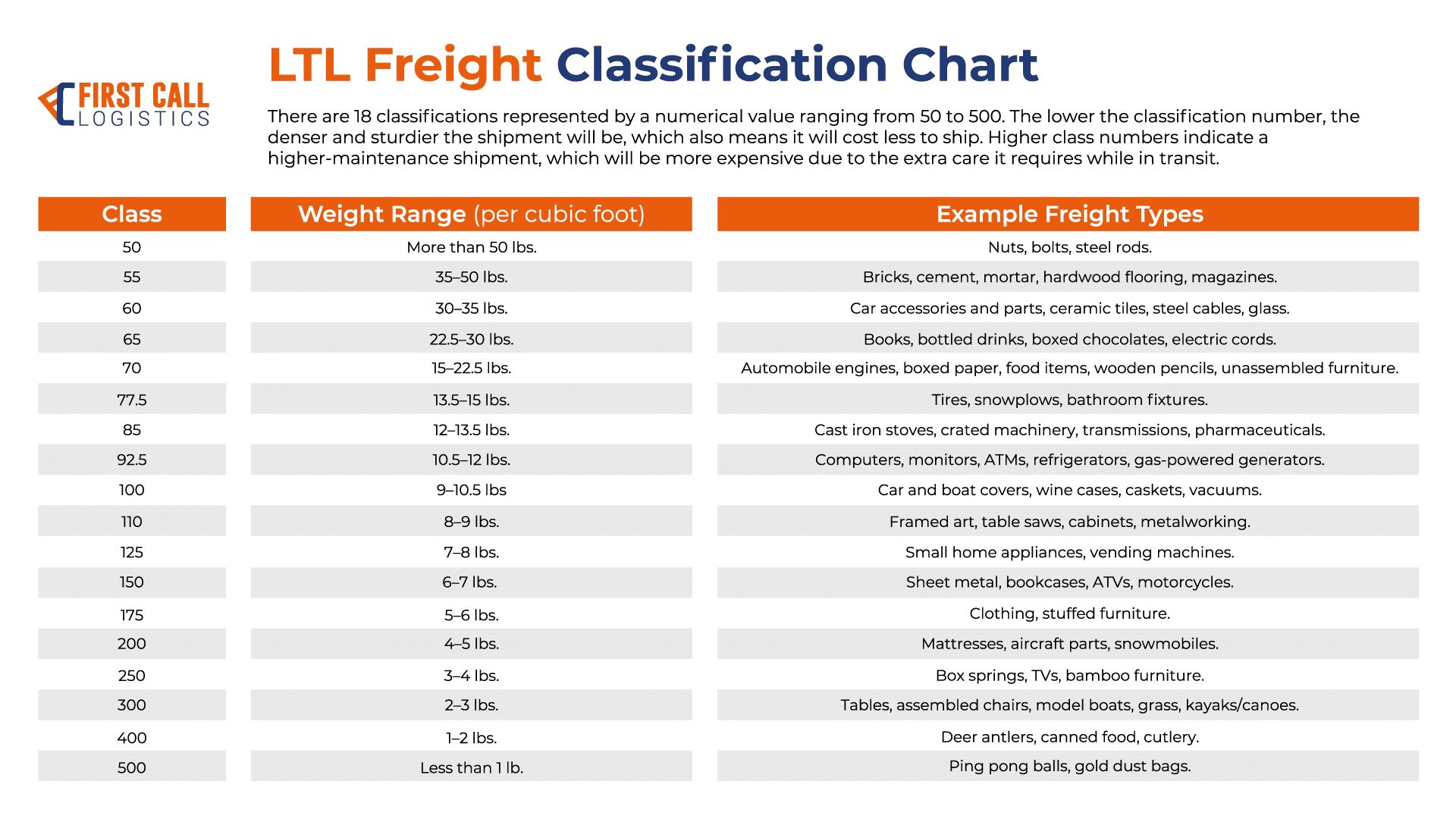
The same density ranges are summarized below in table form for quick reference.
| Freight Class | Density Range (lbs/cu ft) | Example Freight |
|---|---|---|
| 50 | More than 50 | Nuts, bolts, steel rods |
| 55 | 35–50 | Bricks, cement, hardwood flooring |
| 60 | 30–35 | Automotive parts, ceramic tile, steel cables |
| 65 | 22.5–30 | Books, bottled beverages, electric cords |
| 70 | 15–22.5 | Automobile engines, paper products, unassembled furniture |
| 77.5 | 13.5–15 | Tires, snowplows, bathroom fixtures |
| 85 | 12–13.5 | Cast iron stoves, crated machinery |
| 92.5 | 10.5–12 | Computers, monitors, generators |
| 100 | 9–10.5 | Car covers, wine cases, vacuum cleaners |
| 110 | 8–9 | Framed artwork, cabinets, machinery |
| 125 | 7–8 | Small appliances, vending machines |
| 150 | 6–7 | Sheet metal, bookcases, motorcycles |
| 175 | 5–6 | Clothing, upholstered furniture |
| 200 | 4–5 | Mattresses, aircraft parts |
| 250 | 3–4 | Box springs, televisions |
| 300 | 2–3 | Tables, assembled chairs, kayaks |
| 400 | 1–2 | Deer antlers, cutlery |
| 500 | Less than 1 | Ping pong balls, gold dust |
Lower freight classes typically represent denser shipments that are easier to handle and transport, while higher classes reflect lighter freight that may require additional care during transit.
When to Seek Help With Freight Classification
Determining the correct freight class can be challenging, particularly for organizations that ship LTL freight infrequently or move products with unique handling requirements.
Third-party logistics providers (3PLs) regularly work with NMFC classifications and can help review shipment details, confirm density calculations, and verify that the appropriate freight class is assigned before a shipment is tendered.
If you need help reviewing shipment details or validating a freight class, the First Call Logistics team can review the shipment and help determine the appropriate NMFC code.
Have Questions About Freight Shipping?
Freight planning often requires evaluating shipment details, equipment requirements, and carrier options. If you have questions about freight classification, LTL shipping, or shipment planning, our team can help review the details.