
Understanding Partial Truckload and Volume LTL Shipping
Shipments that are too large for standard less-than-truckload (LTL) shipping but not large enough to require a full truckload often fall into a middle category. Two common options for these shipments are partial truckload and volume LTL shipping.
Both approaches allow companies to move larger palletized shipments without paying for an entire trailer. Understanding the differences between these shipping options can help shippers choose the most efficient and cost-effective solution for their freight.
What Is Partial Truckload and Volume LTL?
Partial truckload, sometimes called a shared truckload, is used for shipments that are too large for traditional LTL carrier networks but do not require a full trailer. These shipments typically move directly between pickup and delivery locations without passing through multiple LTL terminals, which can reduce handling and improve transit times.
Volume LTL is another option for larger shipments that exceed standard LTL pallet or weight thresholds but still move through LTL carrier networks. Volume LTL shipments are typically priced differently than standard LTL freight and may be consolidated with other shipments moving to similar destinations.
What’s the Difference Between Partial Truckload and Volume LTL?
Partial truckload and volume LTL shipments both help companies move freight that is too large for standard LTL shipping but does not require a full trailer. While the two options share some similarities, they operate differently within transportation networks and are often priced and scheduled differently.
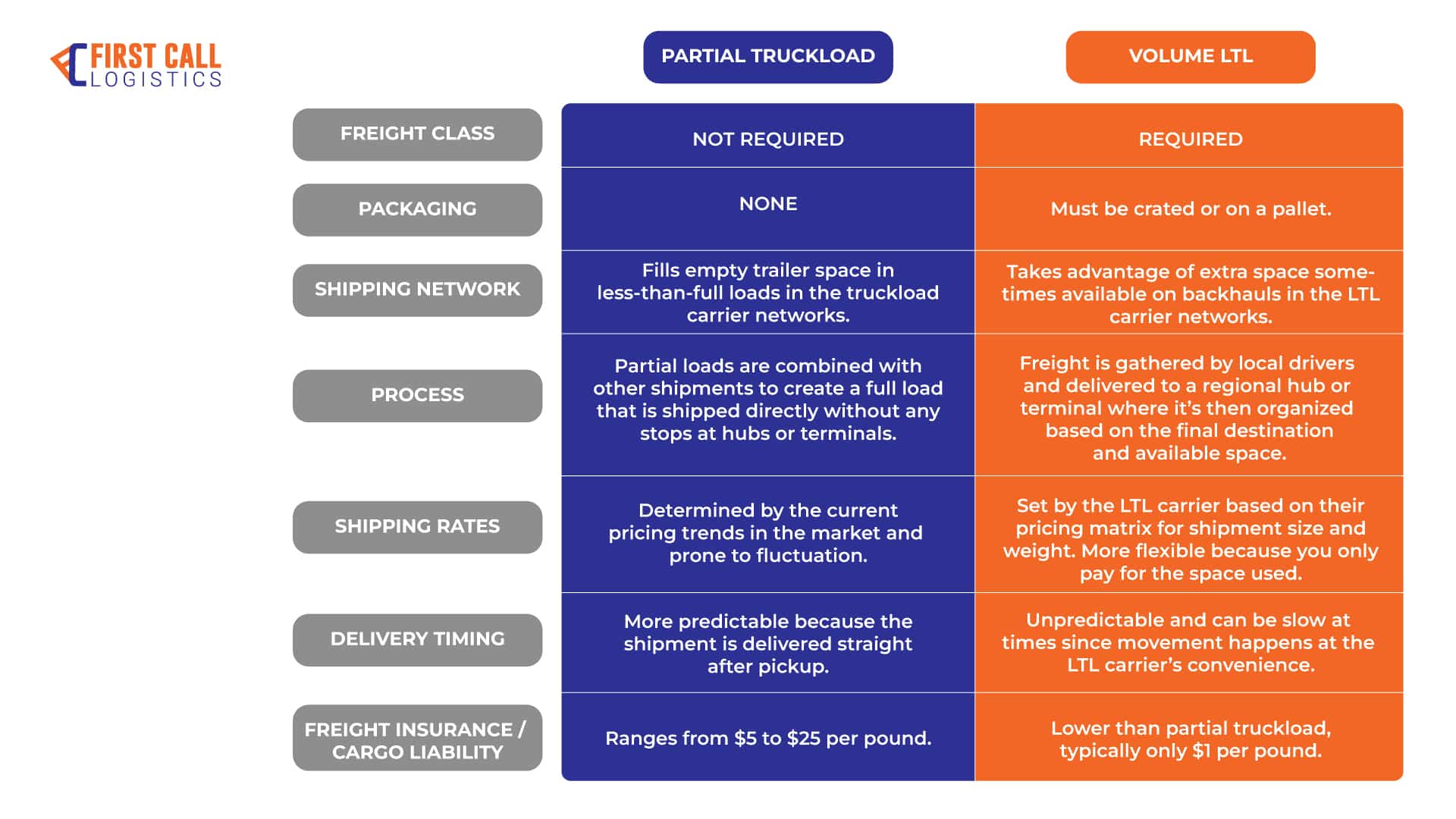
Partial truckload shipments typically move directly between pickup and delivery locations with fewer handling points along the way. Volume LTL shipments, on the other hand, usually move through LTL carrier networks where freight may be consolidated with other shipments moving to similar destinations.
The comparison below highlights some of the most common operational differences between partial truckload and volume LTL shipping.
Partial Truckload vs. Volume LTL Comparison
Can You Replace Standard LTL Freight with Volume LTL?
As a cost-saving option for smaller palletized shipments, standard LTL shipping remains a common choice for moving freight through established carrier networks. Volume LTL does not replace standard LTL freight. Instead, it offers another option for shipments that exceed normal LTL size or pallet thresholds but still move through LTL networks.
What Are the Benefits of Volume LTL and Partial Truckload?
No business wants to pay for unused trailer space. Volume LTL and partial truckload shipping give shippers a way to move larger freight more efficiently without committing to a full trailer.
For many shipments, these options can create cost advantages while making better use of available trailer capacity. Partial truckload shipments often move with fewer handling points than freight traveling through standard LTL terminal networks, which can help reduce transit risk for certain products. Volume LTL can also be a practical option when freight can be consolidated efficiently within an LTL network.
Which Is Better: Volume LTL or Partial Truckload?
As with many logistics decisions, the better option depends on the shipment.
For shippers that need more direct transit and fewer handling points, partial truckload is often the better fit. For businesses with more flexible delivery windows, volume LTL may offer a more cost-effective solution.
Shippers evaluating these options should consider freight size, handling sensitivity, delivery timelines, and how the shipment will move through the network. In many cases, working with an experienced logistics provider can help determine whether truckload or LTL shipping is the better starting point before narrowing the choice between volume LTL and partial truckload.
Frequently Asked Questions About Partial Truckload and Volume LTL
What Is Partial Truckload Shipping?
Partial truckload shipping is used for freight that is too large for standard LTL service but does not require a full trailer. These shipments typically move more directly than standard LTL freight and often involve fewer handling points along the way.<
What Is Volume LTL Shipping?
Volume LTL shipping is designed for larger shipments that exceed standard LTL size or pallet thresholds but still move through LTL carrier networks. It gives shippers another option for moving larger freight without paying for a full truckload.
What Is the Difference Between Partial Truckload and Volume LTL?
Partial truckload shipments usually move with fewer stops and handling points than volume LTL freight. Volume LTL typically moves through LTL networks, where freight may be consolidated with other shipments traveling to similar destinations. The right option depends on shipment size, delivery requirements, and handling sensitivity.
When Should Shippers Use Partial Truckload Instead of Volume LTL?
Partial truckload is often a better fit when freight needs more direct transit, fewer handling points, or tighter delivery control. Volume LTL may work well when delivery windows are more flexible and cost efficiency is the main priority.
Partial truckload and volume LTL both give shippers a way to move larger freight without paying for a full trailer. The right option depends on shipment size, handling requirements, delivery timelines, and how the freight will move through the carrier network. Understanding these differences can help companies choose a shipping strategy that supports both cost control and operational efficiency.
If you would like help evaluating which option fits your operation, contact our team to learn more.
Freight Support from First Call Logistics
First Call Logistics helps shippers evaluate transportation options, coordinate freight movement, and match shipments to the right mode based on timing, handling requirements, and cost considerations.